Cold calls fail when they start from zero.
The problem is calling someone with no context and expecting them to care in the first 20 seconds.
Buyers are not allergic to calls. RAIN Group found that 69% of buyers accepted calls from new providers in the previous 12 months.
But trust is lower now. Hiya’s 2024 State of the Call report found that 46% of unidentified calls go unanswered, even when legitimate businesses are calling.
In the Fix Your Outbound webinar, Harinie put it simply: calling should not just be a meeting-booking channel. It can also test which problem statement, value proposition and objection actually show up in the market.
When should you actually call?
Not every signal deserves a call.
This is where teams overdo it.
Someone opened your email? Relax.
Someone downloaded a report? Still not enough.
But if a good-fit account has a timing signal, a problem signal and some engagement, the call starts to make sense.
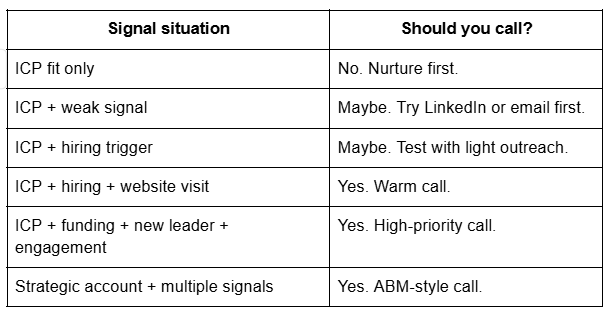
The point is simple.
Do not use the phone to create relevance from nothing.
Use it when relevance already exists.
Use calling to test the market
Most teams judge calling only by meetings booked.
That is too narrow.
A call can tell you things email cannot.
After 20 connected calls, review:
- which opener got people to stay
- which problem statement made them respond
- which value prop landed
- which objection repeated
- which role actually owned the problem
- which segment had real urgency
If one opener fails across 20 conversations, change it.
If one problem statement gets people talking, use it in your LinkedIn and email copy.
That is how calling improves the whole outbound motion.
Where calls fit with LinkedIn, email and WhatsApp
Each channel has a job.
LinkedIn: earn familiarity and start a problem-led conversation.
Email: send proof, detail, numbers and case studies.
Calling: test urgency and qualify faster.
WhatsApp: follow up where prior engagement already exists, especially in India and APAC.
ABM: use when multiple signals stack up on a high-value account.
For the full model, read: Signal-Led Outbound: How B2B Teams Can Find Buyers Who Are Actually in Market.
Bottom line
Cold calling is not the enemy.
Calling without context is.
If the account fits, something has changed, and your opener connects to that change, the call has a much better chance of becoming a real conversation.
FAQs:
1. What is the difference between cold calling and warm calling?
Cold calling starts from a list. Warm calling starts from a signal, trigger or prior engagement.
2. Is warm calling better than cold calling?
Usually, yes. Warm calling gives the buyer a clearer reason to stay on the call.
3. What are good warm calling signals?
Funding, leadership changes, hiring spikes, website visits, webinar attendance, LinkedIn engagement, email replies and pricing page visits.
4. Should every signal trigger a call?
No. Some signals should trigger nurture, content or LinkedIn engagement. Calls should be used when account value and signal strength justify it.