Most outbound treats buyers like income brackets.
Can afford it = must want it.
That is the mistake.
If someone has the money to buy a ₹1.2L TV, does that mean they are looking for one today?
No.
They could be happy with the TV they already have. They could be saving for something else. They could have zero interest in electronics right now.
But if someone walks into Croma and starts comparing TVs?
Different story.
Now there is context.
Now there is intent.
And a specific buying window.
B2B outbound works the same way.
A company may fit your ICP perfectly. Right industry. Right size. Right geography. Right revenue. Right persona.
Still does not mean they care.
That is where signal-led outbound comes in.
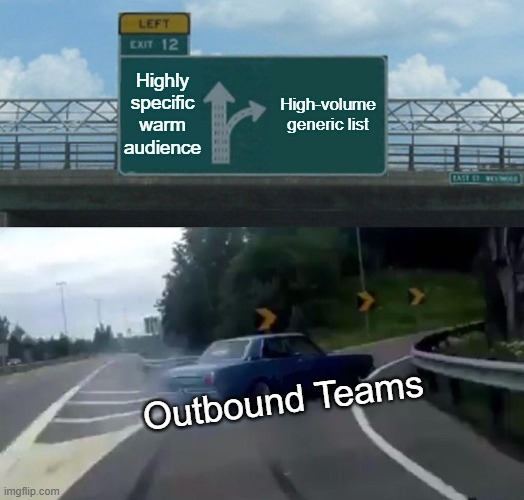
What is signal-led outbound?
Signal-led outbound is the process of reaching out to accounts based on fit, timing, context and buying signals, not just a static ICP list.
In simple words:
You are not reaching out only because someone could buy.
You are reaching out because something suggests the problem may be active for them now.
That “something” could be:
- recent funding
- a new CRO, CMO, VP Sales or Head of IT
- hiring SDRs, BDMs or RevOps roles
- expansion into a new region
- a technology change
- website visits
- webinar registrations
- content downloads
- LinkedIn engagement
- competitor or agency usage
But the signal alone is not the magic.
The real work is understanding what that signal means.
Funding does not mean “pitch them now.”
Funding may mean they have budget. But what are they likely investing in? Hiring? Expansion? RevOps? Demand gen? New markets?
That interpretation is what makes the outreach useful.
Why traditional outbound is getting ignored
Outbound used to be simpler.
Find the ICP. Buy the list. Write a decent message. Send at volume. Book meetings.
That time and those days are gone.
Today, data is easier to find. AI has made decent messaging easier to produce. Every founder, agency, consultant and software company can reach the same buyer with the same type of message.
So buyers are tired.
Their inbox is full. LinkedIn is noisy. Their calendar is protected. And they have learned to ignore anything that does not feel immediately relevant.
This is not only an outbound problem.
Content is noisier too. Ads are noisier. Social is noisier. Every channel has become more crowded.
Outbound just gets blamed faster because it is more direct.
ICP is not enough
Your ICP tells you which market you want to sell to. It helps you define industry, geography, revenue, company size, business model and persona.
But ICP only answers one question:
Who could buy?
It does not answer:
- who is ready now?
- who has urgency?
- who owns the problem?
- what changed inside the account?
- what message should we send?
- should this account get nurture, outbound, warm calling or ABM?
That is why many good-fit accounts still do not reply.
They are not always bad accounts.
They may just be bad-timing accounts.
The four signal types B2B teams should track
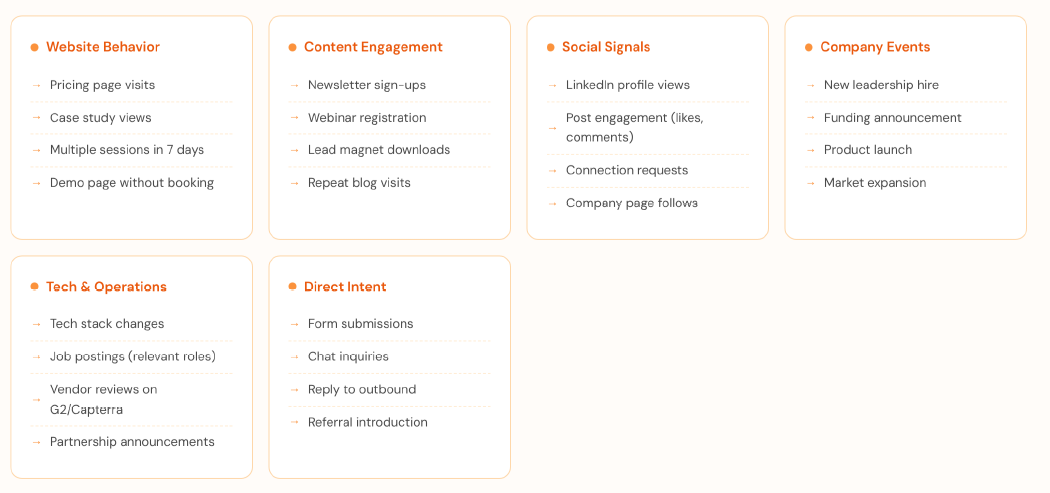
At Leadle, we usually think about signals in four layers.
1. Fit signals
These tell you whether the company belongs in your market.
Examples:
- industry
- company size
- geography
- revenue
- stage
- business model
Fit signals help you avoid wasting effort on accounts that should never be in the campaign.
2. Problem signals
These tell you whether the problem may exist.
Examples:
- hiring a specific role
- growing a department
- still doing things manually
- using a tool that may not scale
- expanding operations
- showing signs of process strain
This is where outbound starts becoming more useful.
You are no longer saying, “You look like a company we sell to.”
You are saying, “This specific thing may point to a problem we solve.”
3. Timing signals
These tell you why the problem may matter now.
Examples:
- new leadership
- funding
- new market entry
- restructuring
- compliance deadline
- hiring spike
- expansion plans
Timing is the difference between a relevant message and a random one.
4. Engagement signals
These tell you whether the account or person has shown interest in your topic.
Examples:
- website visit
- pricing page visit
- webinar registration
- report download
- case study view
- LinkedIn engagement
- email reply
Engagement signals are useful, but they need context.
Someone opening an email is not the same as someone being ready to buy.
Calm down. They only opened the email.
How you string signals together matters.
A single signal can be weak.
A company getting funded does not automatically need your product.
A person liking your LinkedIn post does not mean they have budget.
A website visit does not mean the buying committee is active.
But signals stacked together are different.
Example:
A B2B SaaS company just raised Series A.
- They hired a new VP Sales.
- They are hiring SDRs.
- They are expanding into the US.
- Their Head of Revenue visited your RevOps page.
Now you have a stronger reason to act.
The account fits. There is a problem signal. There is timing. There is behaviour.
That account should not be treated the same as a random company from a database.
Not every signal should trigger sales outreach
Some signals should trigger nurture.
Some should trigger content.
Some should trigger LinkedIn engagement.
Some should trigger warm calling.
Some should trigger direct sales outreach.
Some deserve one-on-one ABM.
The action depends on signal strength and account value.
A simple routing model:
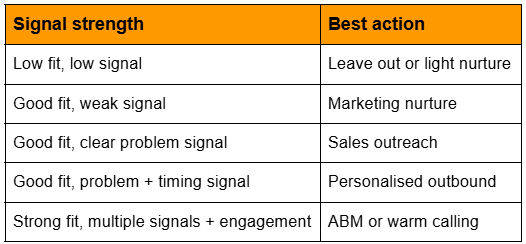
This is how you balance volume and precision.
You do not need to send sales messages to everyone.
You need a large enough market to nurture, and a sharper set of accounts for sales effort.
Where LinkedIn, email, calling and WhatsApp fit
Signal-led outbound is not only an email strategy.
Each channel has a job.
LinkedIn is useful for starting a problem-led conversation with decision-makers. It works well when the message is direct, simple and tied to the person’s priorities.
Email works better when you have more context, proof and specificity. It is no longer the best channel for large-volume generic outreach. It is stronger for low-volume, relevant, one-on-one outreach.
Calling works best when it is not blind.
A warm call after signals is very different from calling 500 numbers from a list.
For example:
“Noticed your team has been hiring SDRs after expanding into the US. Usually this is when lead routing and outbound reporting start getting messy. Wanted to check if that is something your team is already looking at.”
That call has a reason to exist.
In India and APAC, WhatsApp can also work well for follow-ups, especially after a LinkedIn connection, webinar registration, sales conversation or prior engagement.
For more on this, read: Where Calling Fits in Signal-Led Outbound.
Why smaller lists are not a bad thing!
Signal-led outbound makes teams uncomfortable because the list gets smaller.
That is expected.
If you are selling TVs, the number of people who can afford one may be huge.
The number of people standing in Croma comparing TVs today is much smaller.
But which group would you rather spend sales effort on?
A smaller list is not the problem.
A lazy list is the problem.
When you reach out to a smaller, better-reasoned group, you learn faster.
You can see:
- which segment responded
- which signal mattered
- which role cared
- which problem created interest
- which timing worked
- which meetings were actually qualified
That learning gets lost when you blast the same message to 5,000 people and then stare at a 1% reply rate wondering what happened.
How to start with signal-led outbound
Start simple.
Pick one ICP segment.
Pick one problem you believe is active in that segment.
Pick one or two timing signals.
Pick one role.
Write one exploratory message.
Then track properly.
Not just replies.
Track:
- which signal led to the reply
- which role responded
- what objection came up
- whether the problem was real
- whether it turned into a meeting
- whether the meeting was qualified
This is how outbound becomes a learning system, not just an activity machine.
If you want to map this for your own GTM motion, download the Signal-Led Outbound Whiteboard or explore Leadle’s Outbound Execution model.
This article is based on Leadle’s Fix Your Outbound webinar. Check the full video for a deeper breakdown.
FAQs
What is signal-led outbound?
Signal-led outbound is a B2B outbound approach where teams use buying signals, account context and timing to decide who to contact, what to say and how much sales effort an account deserves.
How is signal-led outbound different from traditional outbound?
Traditional outbound usually starts with ICP and volume. Signal-led outbound starts with ICP, then adds problem signals, timing signals and engagement signals before deciding the outreach motion.
Is signal-led outbound only for SaaS companies?
No. It can work across B2B SaaS, IT services, consulting, manufacturing, ESG, HR, logistics and other B2B sectors. The signals change by industry, but the principle stays the same.
What are examples of buying signals in B2B sales?
Common B2B buying signals include funding, leadership changes, hiring spikes, expansion, technology adoption, website visits, webinar registrations, content downloads and LinkedIn engagement.