Should you hire an outbound agency or build an in-house SDR team? Neither, until you know which stage you're in. Pre-validation, the motion is still the founder's job. Post-validation and pre-scale, an agency builds the system faster than you can hire for it. Scale-ready, you hire in-house and own it. Stage decides. Not budget.
Ten years running Leadle. I've had this conversation more times than I can count.
So let's get real about it.
Outsourcing doesn't fix a broken motion. If your messaging is unclear or your ICP is wrong, an agency just executes that badly, faster. In-house isn't automatically better either. Not if you don't have the system to support it.
The real question isn't agency vs. in-house. It's where you actually are, and what you're building toward.
Why most founders get this decision wrong
They pick the option first.
Hire SDRs. Sign an agency. Keep doing it themselves. Then try to build the motion around whatever they picked.
Six months in, outbound isn't working. And now there's no way to tell what broke. The people? The agency? The motion itself, which nobody ever validated?
So they switch. Fire the SDRs. Cancel the agency. Try something else. Six more months gone.
The stage you're in decides the option. Not the budget. Not what the last founder you talked to did.
What are the three stages of outbound maturity?
There are three: pre-validation, post-validation pre-scale, and scale-ready. Each one has a different correct answer to the agency vs in-house question.
1. Pre-validation. Most of your customers came through your network. Referrals. Warm intros. Old relationships. You don't yet know if strangers convert.
2. Post-validation, pre-scale. You've closed a handful of cold deals. There's a pattern. You know the ICP, the message, the channel that worked.
3. Scale-ready. The motion is documented well enough that someone else could run it without you in the room.
When is founder-led sales still your job?
Founder-led sales is still your job until strangers buy. If your pipeline comes from referrals and warm intros, you haven't validated cold outbound yet, and there is nothing for an SDR or an agency to run.
In most founder-led companies, the early pipeline comes from the founder. Old relationships. Referrals. A few deals that happened because the founder knew exactly what to say and when to say it.
That's not a bad thing. It's usually how the company gets its first real customers.
The problem starts when this stays the only way pipeline gets created. Because then sales isn't a function yet. It's still sitting inside the founder's head.
Who to target. What pain to lead with. Which accounts are worth chasing. When to follow up and when to walk away.
Until that judgment becomes a system, everything downstream inherits the same confusion.
How many customers should a founder close themselves?
Jason Lemkin's rule of thumb, published on SaaStr, is that founders should close their first 10 to 30 customers themselves. Reps hired before that point tend to close almost nothing. The motion they're supposed to run doesn't exist yet.
Five signs you're not ready to hand outbound off
- Your top deals last quarter came through your network.
- You can close a cold meeting but nobody else on the team can.
- Your ICP is still shifting month to month.
- Your messaging changes based on who's in the room.
- You haven't yet had a stranger, from cold outreach, take a meeting and buy.
More than two of these true? It's still your job. No agency fixes this. No SDR fixes this.
When does an outbound agency actually earn its keep?
Hire an outbound agency when you need a system, not bodies. Sequences, signal triggers, tooling, deliverability infrastructure, reporting. An agency is renting expertise and infrastructure, not SDRs.
The distinction matters, because most agencies sell you SDRs for rent. That's the version that fails.
An agency is the right call when:
- You need pipeline in 60 days, not 6 months.
- You don't have the bandwidth to run an SDR team yet.
- You're entering a new geography with no local fluency.
- You're the closer, and your calendar needs protecting.
- You don't own sending domains, enrichment waterfalls, or attribution tracking, and building that takes months.
One thing to insist on. Sending domains and inboxes sit in your tenant, not the agency's. You keep the reputation when the engagement ends.
When should you hire your first SDR?
Hire your first SDR after the motion is validated and documented. SDR #1 runs a playbook that already works. Their job is repetition, not invention.
The prerequisite most founders skip is a working, documented motion. SDR #1 shouldn't be discovering the market. That's your job, or the agency's job, before this point.
Four things that must exist before you hire SDR #1
- A validated ICP. With a handful of closed cold deals matching it.
- A documented outbound playbook. Not in one person's head.
- Someone to manage them. If nobody's coaching cadence, quota, and objections, the SDR fails.
- 6 to 12 months of runway on the hire. Which brings us to ramp.
How long does an SDR take to ramp?
Most industry benchmarks put SDR ramp to full productivity at 3 to 6 months. Recruiting adds another 6 to 8 weeks before that. Assume little to no pipeline from a new SDR for the first quarter, and budget for it.
By comparison, an agency with existing infrastructure typically reaches full campaign volume in 4 to 6 weeks, limited mostly by domain warming.
That gap is the entire argument for agencies at the pre-scale stage. It's also the reason agencies are the wrong permanent answer.
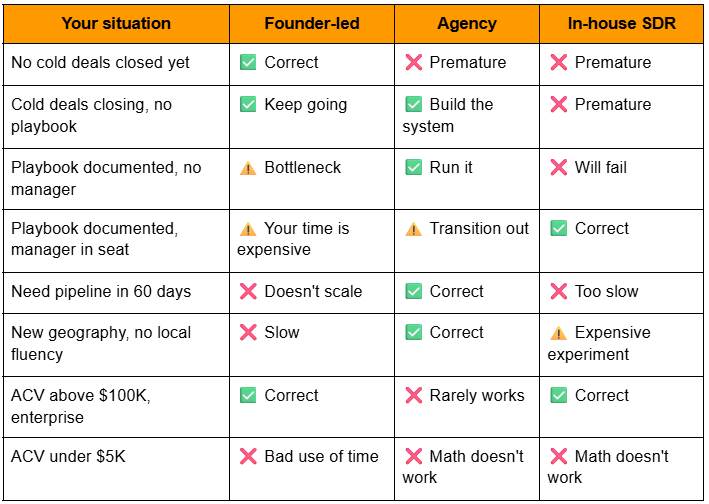
Sub-$5K ACV isn't an outbound problem. Build inbound from day one. That's the real engine at that price point.
The hybrid model most founders miss
You don't have to pick one. The move that works most often at Series A and early Series B is agency and founder-led running together.
- The agency builds the system. Sequences, signal framework, tooling, dashboards, deliverability.
- The founder validates the motion. Taking the meetings. Iterating messaging weekly.
- Three to six months in, once the motion is real, layer in the first SDR hire. They inherit a system, not a blank page.
- Six to twelve months in, bring the whole thing in-house.
The agency is a bridge. If it's still there at month 24 doing the same work, something went wrong.
The mistake to avoid at every stage
Don't switch when a motion fails. Diagnose why it failed first.
The actual problem is usually upstream. Wrong ICP. Wrong message. Wrong channel mix. Swapping the executor doesn't fix any of those. It just resets the clock and buys you another six months of not knowing.
If you're still on the fence, deal size is the tiebreaker
Stage matters most. ACV breaks the tie.
- High ACV, enterprise. I've never seen this work outsourced. Too many stakeholders, too long a cycle. In-house, usually founder-led, from day one.
- Mid-market. An agency genuinely helps. Use it as a test lab for three to five months. Validate messaging, find what converts, then bring it in-house.
- Low ACV, under $5K. Don't bother with an agency long-term. Build inbound.
If you don't own the system, you're always dependent on whoever's running it.
That hasn't changed once in ten years of this conversation.
FAQs:
1. Is an outbound agency cheaper than an in-house SDR?
In year one, usually yes, once you count salary, tools, recruiting, management time, and the ramp period. By year three the math often flips, because in-house learning compounds and setup costs amortize. But cost is the wrong first question. If your motion isn't validated, both options are expensive ways to learn nothing.
2. Can an outbound agency replace an SDR entirely?
For the prospecting function, yes. Not for closing. You still need someone running discovery and working deals. In practice, an agency covers top of funnel while the founder or an AE handles the close.
3. When should I switch from an agency to an in-house team?
When three things are true at once. Outbound is validated as a pipeline channel. A documented playbook exists that a new hire can execute from day one. And you have budget for a 6-month ramp without depending on the agency for coverage.
4. Can I run an agency and an in-house SDR at the same time?
Yes, and it's increasingly common. The agency runs the signal infrastructure, enrichment, sequencing, and attribution. The SDR handles warm follow-up and complex discovery. Run both in parallel during the transition so pipeline doesn't gap.
5. Why do outbound agencies fail?
Most often because the client's ICP or messaging was never validated, and the agency executed the wrong thing efficiently. Second most common reason: the agency was hired as SDRs for rent instead of as system builders, so nothing durable got built and the client was back to zero when the contract ended.