What Is Product Market Fit (PMF)?
In simple terms, product market fit happens when your product solves a real problem for a clearly defined group of people and they love it enough to pay, stay, and tell others about it. It’s that “magic moment” when the market pulls your product forward instead of you having to push it uphill.

But here’s the hard truth: PMF isn’t a one-time milestone. It’s a moving target. Markets evolve, competitors emerge, and customer expectations shift. To keep growing, founders must continuously test whether their product still fits the market’s needs.
Also Read: Why a One-Size-Fits-All GTM Strategy Will Fail You
Why Product Market Fit Matters More Than Growth
Many startups fall into the trap of scaling before achieving PMF. Growth without fit is like building a skyscraper on sand, impressive at first glance but unstable underneath.
Without PMF, no amount of ads, automation, or funding can sustain traction.
The Product Market Fit Framework (also known as the PMF Onion) helps founders uncover why traction is missing and where to focus their efforts.
Introducing the Product Market Fit Framework (PMF Onion Model)
Imagine product-market fit as an onion. Each layer represents a different level of your business - from surface-level marketing tactics to the core product itself.
To truly find PMF, you must peel back these layers and make sure every part of your organization is aligned.
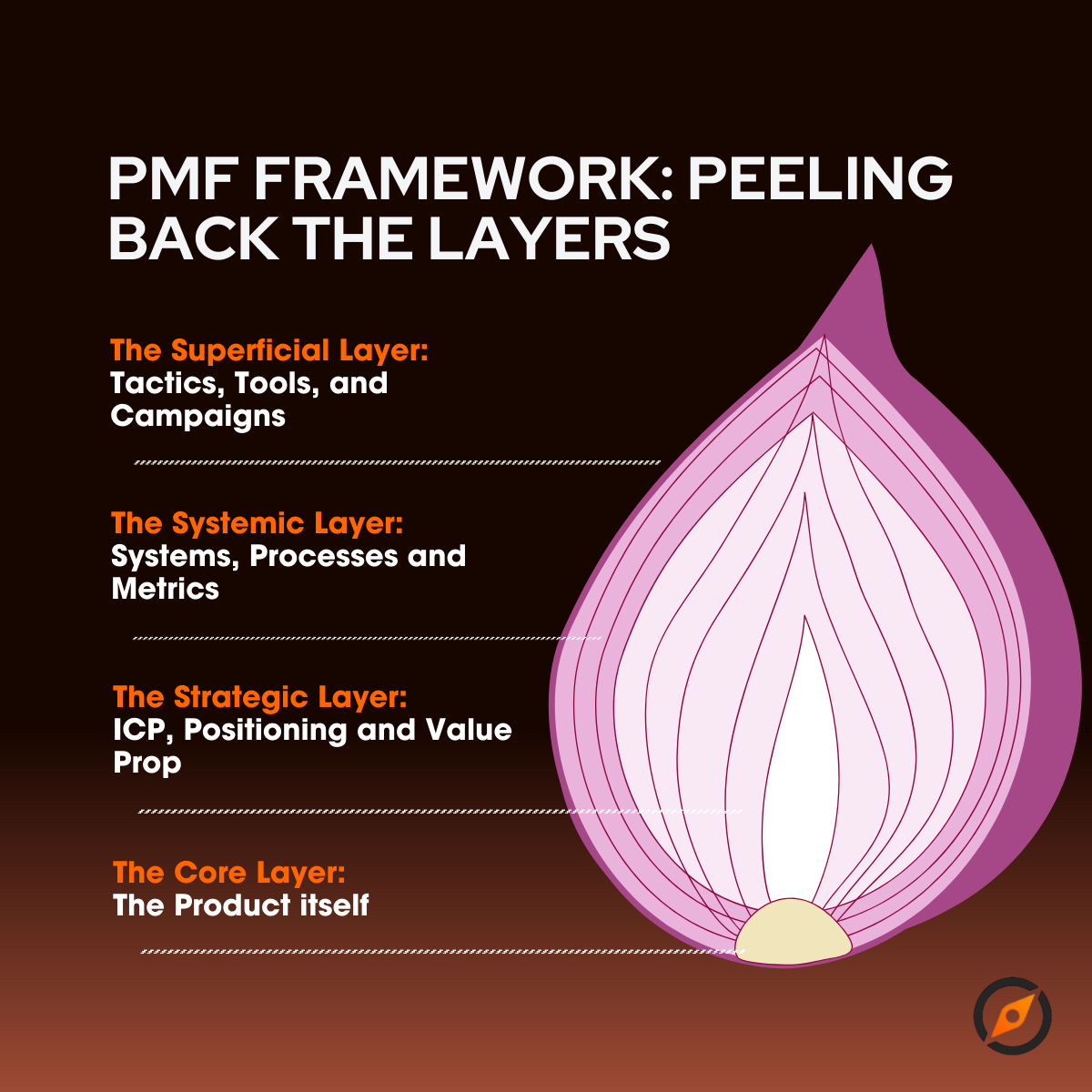
The Four Layers of the PMF Onion
1. The Superficial Layer: Tactics, Tools, and Campaigns
This is where most teams spend their time – optimizing ads, tweaking landing pages, building email funnels, and testing new creative ideas. These efforts matter, but they only scratch the surface.
Key elements include:
→ Marketing channels (paid, organic, social)
→ Content strategy (blogs, case studies, videos)
→ Automation and campaign workflows
→ Conversion tactics (referrals, free trials)
The trap: Over-focusing on this layer creates the illusion of progress without solving the real problem. It’s like repainting the walls while the foundation cracks beneath you.
2. The Systemic Layer: Systems, Processes, and Metrics
This layer involves the infrastructure that supports your product and marketing engine:
→ Operational processes and team workflows
→ Budget allocation and cadence
→ Metrics and KPIs that track acquisition, activation, retention, and revenue
→ If the superficial layer is the “what,” this is the “how.”
But even with flawless systems, if the strategy is off, growth will stall.
3. The Strategic Layer: ICP, Positioning, and Value Proposition
This is where things get real. The strategic layer defines who you’re building for, why it matters, and how you communicate that value.
Common issues:
→ Vague Ideal Customer Profile (ICP)
→ Weak or generic value proposition
→ Confusing or “me-too” positioning
Most PMF breakdowns happen here. Without clarity at this level, your marketing won’t resonate, and your product will feel irrelevant, no matter how great your execution.
4. The Core Layer: The Product Itself
At the center of the PMF onion lies the product - the beating heart of everything.
If the product doesn’t deliver meaningful value or fails to solve a real pain point, all the outer layers crumble.
Ask yourself:
"Does our product truly solve a must-have problem?"
"Are users thrilled enough to tell others?"
"Does our differentiation stand the test of competition?"
When in doubt, go back to the product. Even the best marketing strategy can’t fix a broken core.
Digging Deeper: Why Founders Focus on the Wrong Layers
The Comfort Zone Trap
It’s easy to fix what’s visible - ads, landing pages, metrics. These are measurable and controllable. But deep strategic misalignments? They’re uncomfortable to face.
Startups spend months optimizing campaigns while ignoring the elephant in the room: the product doesn’t fully fit the market anymore.
Reason? Founders love complex frameworks, but customers? They just know whether your product matters to them or not.
The Sean Ellis test cuts straight through vanity metrics and asks the only question that truly matters:
“Is this product a must-have or a nice-to-have?”
If 40% or more of your users say “Very disappointed,” congrats - you’re in PMF territory.
If you’re below 40%, don’t panic… but also don’t pour more fuel into the fire. You’ve got misalignment somewhere in the onion layers.
Most products die in the “nice-to-have” zone because founders mistake polite engagement for genuine value. Users might say they “like” your product… but they don’t fight to keep it.
And PMF lives in the fight.
Also Read: Prospecting for B2B Founders
Leadle’s Research: Where Most Startups Go Wrong
After analyzing data from over 250+ startups, we've found that 9 out of 10 PMF problems originate in the strategic layer, not the tactical or operational ones.
Common patterns include:
- Poorly defined customer personas
- Weak or unclear value propositions
- Messaging that doesn’t resonate
- Overly generic positioning
How to Regain Product Market Fit: A Step-by-Step Playbook
1. Revisit Your ICP and Personas
Talk to your users. Find out who loves your product most and why. Narrow your ICP to the audience that gets the most value, then build messaging that speaks directly to them.
2. Refine Your Value Proposition
Revisit your promise. What makes your product irreplaceable? Your value prop should clearly answer, “Why should I choose you?”
3. Reassess Your Positioning and Go-to-Market Strategy
Compare how you’re perceived versus your competitors. Update your messaging to highlight your unique advantage.
4. Realign Teams and Budgets for PMF Recovery
Once you know where the gap lies, align every layer - product, marketing, ops to fix it together. PMF recovery is a company-wide effort, not a marketing task.
Key Takeaways: What the PMF Onion Teaches Us
- Product market fit is multi-layered - tactical, operational, strategic, and product-based.
- Superficial fixes can’t solve deep misalignment.
- True PMF requires humility, iteration, and customer obsession.
- The strategic layer is where most startups lose their way and where recovery begins.
Conclusion: Peeling Back the Layers to Rediscover Fit
The Product Market Fit Framework teaches one timeless truth – great products aren’t discovered; they’re refined.
By peeling back each layer of the PMF onion and aligning them from the surface to the core, founders can uncover hidden gaps, rebuild confidence, and reconnect with their audience.
If you’re struggling to regain traction, stop optimizing the surface and start refining the core.
If you need help or a strategic sounding board, reach out. Happy to show you how to make your product irresistible to your audience.
-- Harinie
FAQs
1️⃣ What is the Product Market Fit Framework?
It’s a layered model that helps startups identify where misalignment exists - from marketing tactics to the core product itself.
2️⃣ Why do startups lose product market fit?
Because markets evolve faster than they do. What worked before may no longer resonate with new customer expectations.
3️⃣ How can I tell if I’ve lost product market fit?
Watch for stalled growth, high churn, and customer confusion about your value proposition.
4️⃣ How long does it take to regain PMF?
It varies – some teams realign in months, others need a full product pivot. The key is continuous feedback and iteration.
5️⃣ Should I change my product or my audience?
Start by refining your audience and messaging. Only pivot your product if you’ve confirmed misfit through customer data.