A lot of B2B teams are doing everything they are supposed to do.
They have SDRs. They are running outbound. They are spending on ads. They have tools, data and activity.
The pipeline still does not move.
In many cases, the problem starts before the campaign.
The company has treated its assumptions about the market as facts. It believes it knows the right audience, the right problem and the right message. None of it has been properly tested.
That was the focus of our recent Fix Your GTM webinar.
This article covers the main ideas from the session and how to apply them to your own GTM.
Why do B2B go-to-market strategies fail?
B2B GTM usually fails when a company scales assumptions before validating them.
A founder builds a product to solve a problem. It is natural to assume they also know:
- Who owns that problem
- Who has the budget
- How urgent the problem is
- Which outcome matters most
- What the buyer needs to hear
Some of those assumptions may be right.
They still need to be tested.
This becomes more important when entering a new market. A message that worked in India may not work in the US. A use case that matters in APAC may not be important to the same role in Europe.
More outreach will not fix this.
More SDRs will not fix it either.
The market has to validate the foundation first.
What is the difference between GTM and sales?
A GTM campaign tests your understanding of the market.
A sales campaign uses what has already been validated.
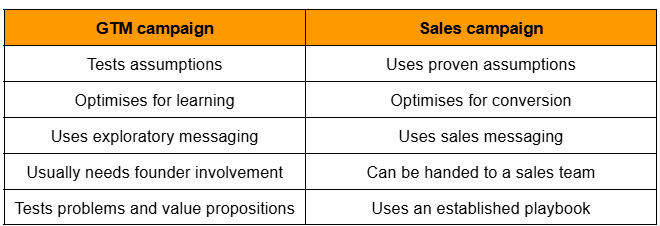
The channels may be the same.
You may still use LinkedIn, email and calls.
The difference is the intent.
In GTM, you are not pretending to know everything about the buyer. You are trying to understand how they think about the problem.
Once that is clear, you can build a sales motion around it.
Build an assumption matrix before writing outbound messages
Most teams start writing messages too early.
Start by mapping what you think you know.
1. Problems
List the problems your product solves.
Choose the two or three that seem most valuable.
2. Buyers
Identify who owns each problem.
The user, decision-maker and budget owner may be different people.
3. Value
List the outcomes your product can create.
This could include:
- Saving time
- Reducing costs
- Increasing revenue
- Improving visibility
- Reducing risk
- Making a process easier to manage
4. Stakeholder relevance
Map each outcome to the person who cares about it.
A founder, CRO and Head of IT may all be involved in buying the same product.
They will not buy it for the same reason.
5. Evidence
Mark what is already supported by customer proof and what is still an assumption.
That gives you a clear set of ideas to test.
How do you validate an ideal customer profile?
An ICP is not validated because a few inbound leads became customers.
It is validated when unfamiliar buyers in a defined market respond to the problem, take meetings and move towards a commercial outcome.
One company discussed during the webinar believed SaaS was its main segment.
When the existing customer base was reviewed, only a small portion of the customers were SaaS companies. Most came from accounting and fintech.
Campaigns were then run across those segments.
Accounting and fintech responded better because the problem was more relevant to them.
The lesson is simple.
Look at who actually buys, not who you assume should buy.
Start with your current customers
Review:
- Industry
- Company size
- Revenue
- Geography
- Buyer role
- Problem solved
- Reason for buying
- Sales cycle
- Deal size
- Retention or expansion
Separate inbound and referral customers from customers won through outbound.
A referral may buy because they trust the person introducing you. A cold prospect needs to understand the value without that trust.
Does your ICP need to be broad or narrow?
Your entire market should not receive the same campaign.
Split it into three levels.
Broad market
This is the larger audience that could buy from you at some point.
Use:
- Thought leadership
- Newsletters
- Webinars
- Case studies
- Educational content
- Retargeting
The goal is familiarity, not an immediate meeting.
Core outbound audience
This is your main ICP.
Use a coordinated mix of:
- Warm calling
- Relevant content
The messaging should connect the product to a known problem or business outcome.
High-priority accounts
These are accounts with stronger fit or timing signals.
Use:
- Manual account research
- Trigger-based messaging
- Existing technology context
- Role-specific use cases
- Account-based outreach
The smaller the list, the more specific the work should be.
How do you write outbound messaging without relying on assumptions?
Early GTM messaging should be exploratory.
You can explain what you have built and the problem it addresses. You should not act as though you already understand the prospect’s exact situation.
A simple structure is:
- State the problem you are working on.
- Explain why the person’s view matters.
- Ask how the issue fits into their priorities.
- Offer a conversation or an email exchange.
Some prospects may not want a meeting.
They may still answer questions over email.
That feedback is useful. It helps you understand the language buyers use, the outcomes they care about and the objections you need to address.
After enough conversations, the message becomes clearer.
That is when the sales copy gets easier.
Good personalisation is based on responsibility
A lot of outbound personalisation is cosmetic.
Mentioning a recent post or adding the company name does not make the message relevant.
Real personalisation starts with what the person is responsible for.
Take Leadle's RevOps as a service as an example.
A founder may care about:
- Pipeline visibility
- Forecast accuracy
- Revenue predictability
A CRO may care about:
- Revenue leakage
- CRM adoption
- Tool costs
- Conversion
A VP of Sales may care about:
- Team productivity
- Campaign execution
- Meeting quality
- Rep performance
The product may be the same.
The reason to care changes with the role.
How should LinkedIn, email and calling work together?
Do not copy the same message across every channel.
Each channel has a different job.
Use LinkedIn for:
- Market observations
- Problems affecting the role
- Industry changes
- Peer-level conversations
- Broader value
Email
Use email for:
- Specific use cases
- Customer examples
- Numbers
- Before-and-after scenarios
- Detailed value propositions
Warm calling
Use calls to follow up with people who have already shown some level of engagement.
That could mean they:
- Connected on LinkedIn
- Opened an email
- Replied but stopped responding
- Visited a relevant page
- Engaged with your content
The call is not there to force a pitch.
It is there to open a conversation.
What does radio silence tell you?
A negative response gives you information.
A positive response gives you validation.
Complete silence gives you neither.
If a campaign receives no meaningful response, something is not landing.
It could be:
- The wrong segment
- The wrong seniority
- The wrong problem
- A weak value proposition
- Poor timing
- Low sender credibility
- Deliverability issues
Change one major variable at a time.
If you change the audience, message, offer and channel together, you will not know what made the difference.
How long does GTM validation take?
There is no fixed timeline.
In our experience working with clients, early signals can appear within two to three weeks. Building a repeatable motion often takes two to three months.
It can take longer when:
- Entering a new geography
- Selling to enterprise buyers
- Targeting a new industry
- Selling a new category
- Working with long sales cycles
The campaign should still be reviewed every two weeks.
Do not keep running the same approach for months when the market is giving you nothing back.
What is signal-led outbound?
Signal-led outbound uses evidence that an account may have a relevant problem or buying window.
A single signal is rarely enough.
Signals become more useful when they are stacked.
For a RevOps campaign, that could look like:
- Series A or Series B company
- Funded within the last two years
- Recently hired a CRO
- Hiring salespeople
- Visited a relevant page on your website
Each signal increases the relevance of the account.
Common B2B signals
- Recent funding
- New leadership hire
- Growth in a department
- Large hiring push
- Layoffs or restructuring
- New market entry
- Existing technology
- Use of a competitor
- Website visits
- Pricing-page activity
- Content engagement
- Manual processes at a growing company
Signals do not prove the company will buy.
They give you a stronger reason to reach out now.
Avoid over-filtering the market
Signal-led outbound can become too narrow.
If you apply too many filters, you may end up with a list of ten prospects and no room to learn.
Use three levels:
- Broad market for marketing
- Core ICP for outbound
- Small priority list for ABM
This keeps the campaign focused without making the market unusably small.
Why must sales and marketing work together?
Cold outbound alone has limits.
A prospect may not be ready when the first message arrives. That does not mean the account is irrelevant.
Marketing keeps the relationship active through:
- Useful content
- Webinars
- Case studies
- Newsletters
- Retargeting
- Market insights
Sales acts when the account shows interest or a buying signal.
The two functions need to share:
- Account activity
- Content engagement
- Reply data
- Pipeline movement
- Objections
- Conversion data
Without that, marketing keeps producing content without knowing what buyers care about, while sales keeps messaging accounts without knowing what they have already seen.
When should a startup scale outbound?
Scale outbound after the founder has validated the motion.
That means showing that unfamiliar buyers in the target market can move through:
- Outreach
- Response
- Meeting
- Opportunity
- Proposal
- Closure
One or two deals from referrals do not prove this.
Before hiring a large sales team, you should know:
- Who to target
- Which problem to lead with
- What value matters
- Which channels work
- What qualifies an opportunity
- Why deals move forward
- Why deals are lost
Without this, you cannot tell whether a failed campaign is a people problem or a strategy problem.
A VP of Sales should scale a working motion.
They should not be expected to discover the entire market from scratch.
How do you compete with a better-funded market leader?
Do not start by going head-to-head.
A larger competitor may already have:
- Strong brand recall
- Customer trust
- More salespeople
- More marketing budget
- Years of customer proof
A cheaper price or a longer feature list may not be enough to make buyers switch.
Look for the gap they have left open.
During the webinar, Harinie shared the example of a company competing in a category led by products such as Gong.
The first approach was to compete directly.
That was difficult. Buyers already trusted the products they were using.
The opening appeared elsewhere.
Some companies used the incumbent product for account executives, but not for SDRs or customer success teams. The company entered through those underserved use cases instead.
The category did not need to be explained.
The customer already had budget.
The company only had to show where the existing setup was falling short.
That sideways entry worked better than asking buyers to replace a product they already liked. More on this here
What are the biggest pipeline red flags?
A large pipeline is not always a healthy pipeline.
Look at movement between stages.
Track:
- Prospect-to-reply conversion
- Reply-to-meeting conversion
- Meeting-to-opportunity conversion
- Opportunity-to-proposal conversion
- Proposal-to-close conversion
- Time spent in each stage
- Last meaningful activity
- Next agreed action
A high number of leads means little if they do not become meetings.
A high number of meetings means little if they do not become opportunities.
A proposal is not progress on its own.
After a proposal is sent, there should be movement:
- Questions
- Stakeholder discussions
- Use-case validation
- Technical review
- Commercial negotiation
- A clear next step
If nothing is happening, the opportunity may not be as real as the CRM suggests.
A practical GTM reset
If your pipeline is not moving, start here.
1. Audit the evidence
Review:
- Existing customers
- Closed-lost deals
- Pipeline conversions
- Reply data
- Objections
- Channel performance
Separate what you know from what you assume.
2. Pick the first variables to test
Choose:
- Two or three segments
- Two or three buyer roles
- Three main problems
- Three to five value propositions
- A small set of relevant signals
3. Run exploratory outreach
Use LinkedIn, email and warm calling.
Ask questions.
Record the language prospects use.
Do not defend every assumption.
4. Review every two weeks
Look for:
- Positive responses
- Negative feedback
- Radio silence
- Meeting quality
- Progression after the meeting
Change one major variable at a time.
5. Document what works
Once you see a repeatable pattern, document:
- Targeting criteria
- Messaging
- Qualification
- Objections
- Follow-up
- Sales stages
- Conversion expectations
That becomes the playbook the sales team can scale.
Fix the foundation before increasing the volume
GTM is not a messaging problem alone.
It is not an SDR problem alone.
It is not a tool problem alone.
The audience, problem, value and timing need to work together.
Validate those first.
Then build the sales motion.
Check your outbound setup
Not sure where your current setup is breaking?
Complete Leadle’s Outbound Diagnostic to assess your:
- ICP
- Messaging
- Execution
- Systems
Once submitted, the Leadle team will review the responses and share a tailored action plan.
About the author
Harinie Sekaran is the Founder and CEO of Leadle. She works with B2B teams on go-to-market strategy, outbound systems, revenue operations and market validation.
Editorial note
This article is based on Leadle’s Fix Your GTM webinar. The examples and timelines reflect Harinie’s operating experience. Results will vary by market, product, deal size and sales cycle.