90% of founders ask the same question after their first outbound campaign in the US: is this working, or is it broken?
You sent 500 emails. You got 6 replies. You booked 1 meeting.
Is that normal? Below normal? Should you stop the campaign, change the copy, change the list, or wait?
The problem is that most reply rate benchmarks on the internet either come from tool vendors trying to sell you their tool, or they mix US, EU, and India data into one number that means nothing.
This post is the number we actually see. Across 10 years of running outbound for B2B teams, 350+ clients, and 400,000+ appointments booked.
What counts as a good cold email reply rate in the US?
In the US B2B market in 2026:
- 1–3% reply rate is normal. This is what most campaigns will produce when the list is decent and the copy is average.
- 3–5% reply rate is strong. This usually means the list is tight, the message is tied to a real signal, and the offer is clear.
- Above 5% is rare. When we see it, it is almost always a small, sharply targeted list with warm signal underneath - not scale.
If your campaign is below 1%, the problem is almost never the subject line. It is usually the list, the timing, or the offer.
What counts as a good LinkedIn outbound acceptance rate?
LinkedIn behaves differently in the US than in India or the rest of APAC.
- Acceptance rates are lower. US buyers are more selective about who they connect with. In our US campaigns, cold connection acceptance runs at around 10%.
- Noise is higher. The average VP or Director in the US receives 20–50 connection requests per week. Most are ignored.
- Message framing matters more than in India. Generic "would love to connect" notes get ignored. Specific, problem-led openers get accepted.
Once someone accepts and starts a conversation, the meeting conversion is what actually matters. In our US LinkedIn campaigns, 1 in every 5 replies converts to a booked meeting.
So the math looks like this: for every 100 cold connection requests, roughly 10 accept, a subset of those reply, and around 1 in 5 of those replies becomes a meeting. The funnel is narrow at the top, but the meetings that come through are usually higher-intent than email.
Why open rates and click rates are not on this list
Open rates stopped being a useful signal in 2021, when Apple Mail Privacy Protection started pre-fetching emails. Every Apple Mail user now shows as "opened" whether they read the message or not.
Click rates in cold email are almost always vanity. Cold emails should rarely contain links in the first send. If your open rate is 60% and your click rate is 8%, you still have no idea if anyone read the email or wanted to reply.
We track: reply rate, positive reply rate, meetings booked, meetings held, opportunities created. That is it.
What actually predicts pipeline
We rank replies on a signal hierarchy. Not every reply is worth the same.
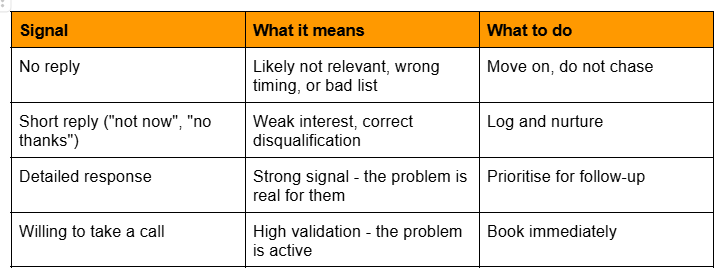
Vanity replies ("interesting", "nice idea", "could be useful") are not validation. They are politeness. Validation looks like: "yes, we are facing this right now" or "this is a real problem for us."
If your campaign produces a lot of replies but few detailed responses and no meetings, you have a targeting problem, not a copy problem.
Also Read: Why Indian SaaS Companies Fail in the US Market (It's Not What You Think)
How US benchmarks differ from India benchmarks
Indian teams selling into the US are usually surprised by three things:
- Reply rates are lower. Indian buyers reply more, even to say no. US buyers ignore.
- Cold calling still works better than expected. In India, cold calls have been dying for years. In the US, warm-triggered calls after a signal still book meetings.
- LinkedIn is more crowded. Every founder, agency, and VC-backed SaaS company is running LinkedIn outbound to the same buyers.
The framing that works in India ("hope this finds you well, would love to explore synergy") gets deleted in the US. The framing that works in the US ("saw you hired a VP Sales last month, usually this breaks reporting, is that on your list") gets ignored in India as too direct.
Same principle, different execution. Adjust for the market.
What to do if your numbers are below benchmark
Do not increase volume, switch tools or blame the channel.
Run the diagnostic in this order:
- List. Are you reaching your exact ICP, or anyone who fits loosely? Tight list beats good copy every time.
- Timing. Is there a signal underneath the outreach - funding, hiring, leadership change, expansion? Or are you cold-blasting a list with no reason for the outreach to exist?
- Offer. Does your message tie to a problem the buyer knows they have? Or are you describing your product?
- Deliverability. Are your emails landing in inbox or spam? Check via a seed test before blaming reply rates.
In our experience, 80% of underperforming campaigns fail at step 1 or step 2. Copy is rarely the actual issue.
Methodology note
The benchmarks in this post come from campaigns run by Leadle for B2B clients between 2022 and 2026. Sample includes SaaS, IT services, and consulting companies with ICPs in the US mid-market and enterprise segments. We count a reply as any human response to a first-touch email. Auto-responses, bounces, and out-of-office messages are excluded. LinkedIn benchmarks are drawn from connection request campaigns run through Aimfox, HeyReach, and Lemlist across the same period.
If you want to see how your numbers stack up, the Leadle Outbound Diagnostic scores your current campaign against these benchmarks in 12 questions.
Want the full playbook?
This post covers the benchmarks. The full playbook covers what to do with them.
How to Validate Your B2B Offer in the US is Leadle's free guide for founders entering the US market. Inside:
- The 3-Layer Validation Model — how to test the right thing before you scale
- Persona wedge selection — finding the buyer closest to the pain
- The 4-step validation method — one assumption, 60–100 contacts, 14 days
- What real validation sounds like (and what fake validation sounds like)
Written for founders who want to stop burning $50K on GTM experiments that were built on the wrong assumptions.
FAQs
What is a good cold email reply rate for B2B in the US?
1–3% is normal, 3–5% is strong. Above 5% usually means the list is small and warm, not that the campaign has cracked cold outbound at scale.
Is a 2% reply rate on cold email good?
Yes, for the US B2B market. If the replies include detailed responses and booked meetings, it is a healthy campaign. If they are all polite dismissals, the targeting is off.
What is a good LinkedIn connection acceptance rate?
15–25% for cold connection requests to US B2B buyers. India-based buyers accept at 30–40%. Anything under 10% suggests the targeting or the note is off.
How many contacts do I need to test a cold email campaign?
60–100 contacts with two message variants is enough to see if the direction is right. If you do not get any signal at that volume, the problem is upstream - the list or the offer - not the copy.