Last updated: October 8, 2026
TL; DR:
Start smaller than you think.
Build a few clear buyer hypotheses. Test them separately. Watch who understands the problem, where urgency already exists, what proof buyers ask for, and which conversations turn into real opportunities.
Then narrow.
Early outbound for a new offer is not only about booking meetings. It is one of the fastest ways to learn who should buy, why they care, how to position the offer, and what deserves to be scaled.
Launching a new product or service creates an awkward GTM problem.
You need customers to understand the market.
But you need to understand the market to know which customers to target.
Outbound can help break that loop.
Not by taking your TAM, loading 10,000 contacts into a sequence and seeing what survives.
By taking samples.
A few buyer groups. Clear hypotheses. Separate campaigns. Real conversations.
Then letting buyer behaviour tell you where to go next.
Bubble Wrap followed a surprisingly similar path.
In 1957, Alfred Fielding and Marc Chavannes created a sheet of trapped air while trying to make textured wallpaper.
Wallpaper did not work.
They tried greenhouse insulation.
That did not become the market either.
The product eventually found its place as protective packaging, with IBM among its earliest major commercial applications.
Same basic product. Three very different markets.
The first market that makes sense on paper is not always the one that buys.
That is worth remembering when you launch something new.
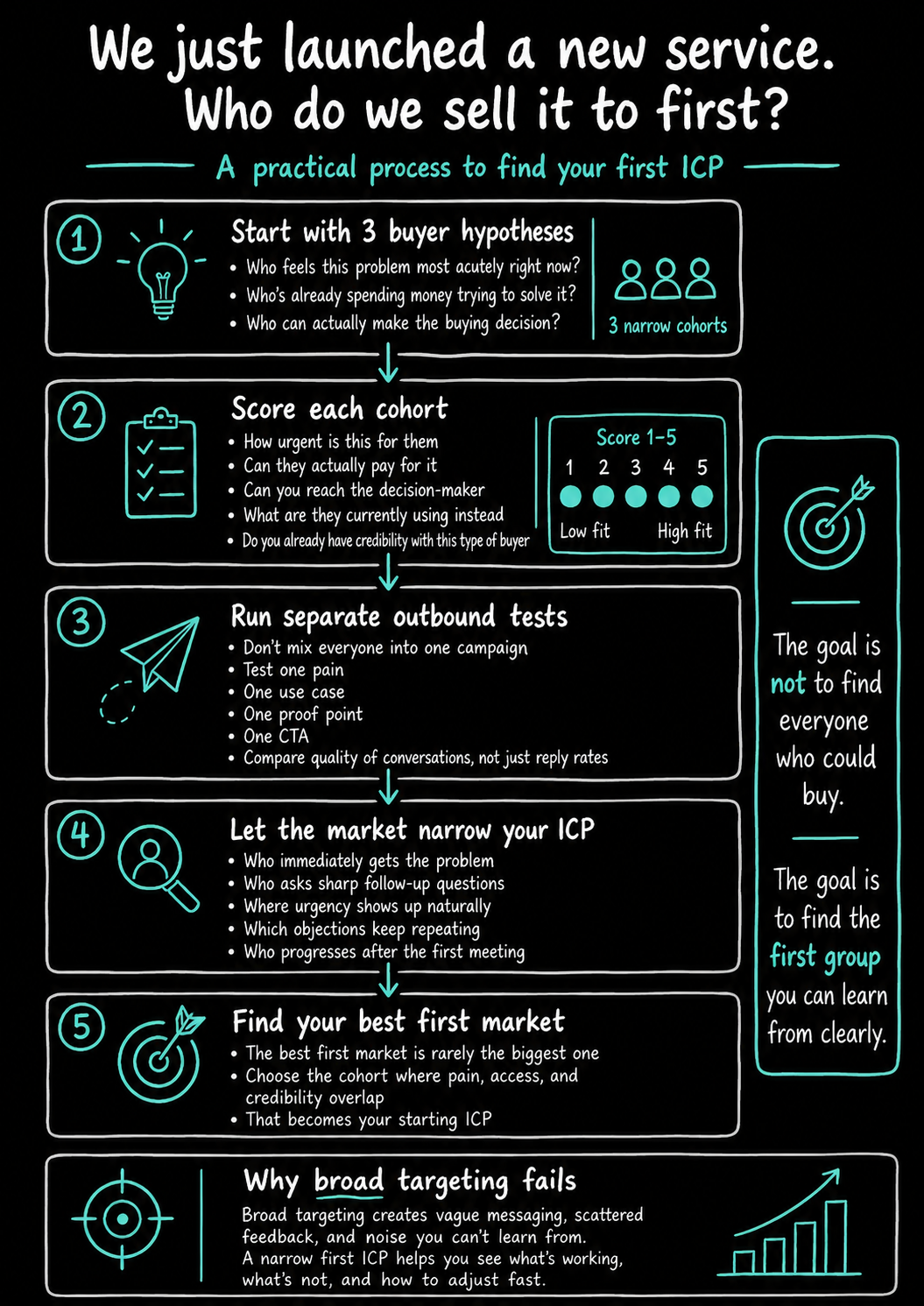
How should you run outbound for a new product or service?
Start with hypotheses, not scale.
A simple version of the process we use looks like this:
Hypothesise → Sample → Read signals → Narrow → Repeat → Scale
Each step answers a different question.
Hypothesise: Who might care?
Sample: Can we test those buyers separately?
Read signals: Who is actually showing interest, and what kind?
Narrow: Which market deserves another round?
Repeat: Does the pattern hold?
Scale: Can we reproduce it without starting from scratch?
Early outbound has two jobs.
It should create pipeline.
It should also make your GTM smarter.
If it is doing neither, something needs to change.
Should you use outbound before you have product-market fit?
You can use outbound before your ICP is fully proven.
You cannot expect it to behave like a mature acquisition channel.
There is an important distinction between:
Outbound for validation
You are still learning:
- who owns the problem
- which use case gets attention
- what creates urgency
- what buyers already use instead
- what they need to believe you
- which segment progresses beyond the first meeting
Outbound for scale
You already know enough of that to reproduce the motion.
The mistake is expecting validation-stage outbound to produce scale-stage economics.
A company entering a new geography, launching a new service line or selling a new product is usually carrying more assumptions than it realises.
The first campaigns should remove some of them.
How do you find the ICP for a new product or service line?
A new ICP usually starts as a working theory.
That is fine.
The problem starts when the theory gets turned into a 20,000-account list before anyone has tested it.
Instead of asking:
Who could buy this?
We prefer:
Who has the strongest reason to buy this first?
That usually gives you much sharper hypotheses.
For each potential buyer group, look at:
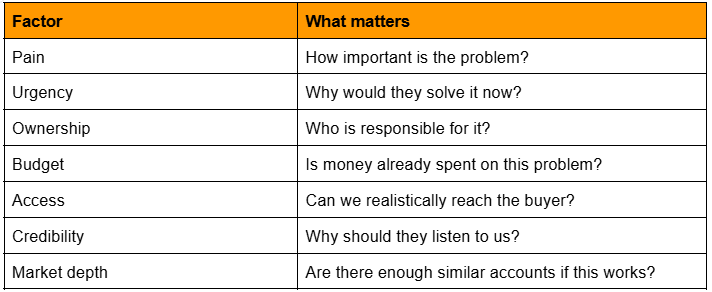
This is also why “mid-market SaaS companies” is not much of an ICP.
It tells you where to find companies.
It does not tell you why they should buy.
For a detailed read: How to Define Your ICP for a B2B Sales Pipeline
The Leadle New-Market Sampling Framework
When the offer or market is new, we would rather compare several small, distinct groups than mix everything into one campaign.
The goal is not to find a perfect ICP in round one.
It is to create enough contrast that differences become visible.
1. Start with 3–4 real buyer hypotheses
They should be meaningfully different.
For example:
Cohort A: CFOs at PE-backed SaaS companies expanding internationally
Cohort B: Controllers at similar companies dealing with multi-entity complexity
Cohort C: Finance Operations leaders at companies hiring rapidly
Same broad market.
Different problem ownership, triggers and reasons to care.
That gives you something worth comparing.
2. Keep the cohorts separate
This sounds basic, but it matters.
If five industries, four personas and three use cases all sit inside one campaign, a 4% reply rate tells you very little.
Which group replied?
Why?
Did one segment produce all the meetings?
Did another reply frequently but never qualify?
Separate cohorts make the answer visible.
3. Give each cohort a clear reason to care
Do not test ten copy variations before you know whether the underlying proposition is relevant.
For each sample, define:
WHO
Who are we speaking to?
WHY
Which problem are we leading with?
WHY NOW
What makes it timely?
WHY US
What makes the claim credible?
WHAT NEXT
What is the smallest useful next step?
Those five variables usually matter much more than whether email two goes out on Day 3 or Day 4.
4. Read beyond reply rates
A high reply rate can still produce bad pipeline.
A lower-replying cohort can turn out to be far more valuable.
We look for signals such as:
- How quickly do they understand the problem?
- Are they asking specific questions?
- Do they recognise the use case without heavy explanation?
- Are relevant stakeholders getting pulled into the conversation?
- Are meetings becoming qualified opportunities?
- Do similar objections repeat?
- Is there a clear reason to act?
The best early market often has a short explanation distance.
You spend less time teaching buyers why the problem matters and more time discussing what they should do about it.
5. Narrow before adding volume
Suppose three cohorts behave like this:
Cohort A replies frequently but rarely progresses after discovery.
Cohort B replies less often but produces stronger qualified conversations.
Cohort C needs a lot of explanation before buyers understand the problem.
That is already useful.
The answer is not automatically:
Let's increase sends across all three and get more data.
The next test may deserve more weight on Cohort B.
This is how the market starts narrowing the ICP for you.
6. Repeat before calling it a playbook
One meeting is interesting.
One large deal is exciting.
Neither automatically proves a repeatable motion.
What gets interesting is when similar accounts start behaving similarly.
The same trigger.
The same pain.
The same stakeholder.
The same objections.
The same type of progression.
Now you have a pattern worth testing harder.
Can you use your existing ICP for a new service line?
Possibly.
Do not assume it.
The company buying your current service may fit the new service perfectly.
The person you currently sell to may not.
Imagine an existing offer bought by a Head of Sales.
The new offer deals with RevOps infrastructure.
Same logo.
Potentially different:
- problem owner
- champion
- economic buyer
- budget
- trigger
- proof requirement
Your customer base gives you somewhere useful to investigate.
It does not automatically give you the answer.
How big should your TAM be before running outbound?
Theoretical TAM is less useful than reachable TAM.
A market may contain 10,000 companies.
After applying:
- size
- geography
- real use case
- buying conditions
- exclusions
- reachable stakeholders
you may discover that only 1,200 make sense.
That changes the campaign.
A 700-account market cannot be treated like a 70,000-account market.
With a small TAM, you generally have less room for careless experimentation.
The motion needs more account research, stronger multichannel coverage and better contact mapping.
A large TAM gives you more room to sample cohorts and compare behaviour.
Neither is inherently better.
They simply require different outbound economics.
What should your first 100 prospects look like?
There is no magic in the number 100.
But it is useful for illustrating the principle.
You could structure the first sample as:
- 25 obvious-fit accounts
- 25 adjacent-fit accounts
- 25 accounts showing a strong trigger
- 25 accounts representing a challenger hypothesis
Then compare what happens.
Not only:
Replies.
Also:
Positive replies → Meetings → Qualified meetings → Opportunities
And alongside the numbers:
- objections
- questions
- competitor mentions
- use cases
- timing signals
- reasons for saying no
This prevents a common mistake: mistaking activity for validation.
Also read: Why More Leads Won't Fix Your GTM
How We Read Early Outbound Signals
New-market outbound creates a lot of noise.
A prospect replying “sounds interesting” feels good.
Three meetings in a week feel even better.
Neither tells the whole story.
We tend to read signals at four levels.
Signal 1: Attention
Are buyers replying?
Useful, but weak on its own.
A provocative message can earn replies without creating any commercial interest.
Signal 2: Recognition
Do buyers recognise the problem?
This is stronger.
You start hearing:
“Yes, we are dealing with that.”
“We have been trying to fix this.”
“That sits with another person internally. Let me bring them in.”
Now the problem is not something you invented in the copy.
It exists in their world.
Signal 3: Intent
Does the conversation start moving?
Look for:
- specific questions
- current alternatives
- timelines
- internal stakeholders
- implementation concerns
- budget questions
- requests for proof
The buyer has moved from understanding the idea to evaluating it.
Signal 4: Repeatability
Does the same pattern appear across similar accounts?
This matters most.
If similar companies with similar triggers keep responding to the same problem, you may have found a useful pocket of the market.
That is much more interesting than celebrating one unusually enthusiastic buyer.
What if nobody responds to the new product?
Do not immediately rewrite the email.
Low response can come from several places:
- wrong accounts
- wrong buyer
- bad data
- deliverability
- weak timing
- irrelevant problem
- unclear message
Messaging is simply the most visible suspect.
We see this often in outbound.
The campaign is weak, so everyone opens the copy document.
Sometimes the copy is innocent.
Also Read: Why Outbound Isn't Working: The 4-Layer Breakdown
What We Change Depending on Where the Funnel Breaks
This is where outbound becomes more useful as a diagnostic tool.
Different failure points imply different problems.
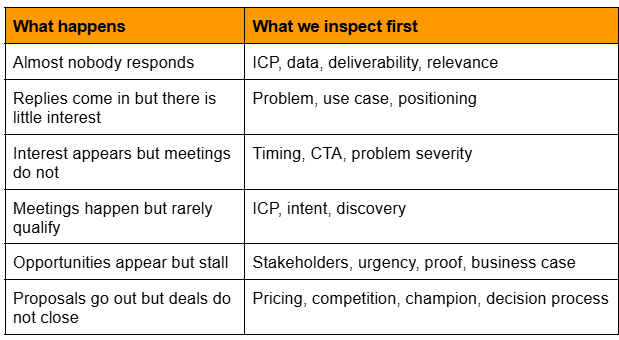
This matters because the wrong fix can make the problem harder to see.
If meetings are happening but none qualify, doubling outbound volume creates more unqualified meetings.
If prospects understand the problem but do not trust the solution, another ICP exercise may not help.
Give the problem an address first.
Then change the layer closest to it.
Want to know where the problem is? Take the Outbound DIagnostic.
How do you write outbound messaging for a new product?
The starting point depends on how familiar buyers already are with the problem.
If buyers understand the category
Get to the relevance quickly.
A simple structure:
Context → Problem → Proof → Next step
They do not need an education campaign.
They need a reason to choose this conversation.
If buyers do not understand the category
Start one step earlier.
Talk about:
- the current workflow
- the cost of the status quo
- a change happening in their environment
- a problem they already recognise
- an outcome they are measured on
Do not make them understand your category before they understand why it matters.
This is also where content becomes part of outbound.
A useful benchmark, teardown, calculator, customer story or point of view can do more work than another “just bumping this up” follow-up.
How do you sell a new service without case studies?
New offers create an obvious credibility gap.
You are selling something you have not sold many times yet.
That does not mean the credibility meter starts at zero.
Useful proof can come from:
- adjacent customer outcomes
- work solving part of the same problem
- founder or team expertise
- relevant industry experience
- prototypes
- pilots
- audits
- methodology
- partnerships
- existing customer trust
The useful question is not:
Do we have the perfect case study?
It is:
What evidence would make this buyer comfortable enough to take the next step?
Different markets answer that differently.
Which is itself another signal worth capturing.
Which channels work best for launching a new B2B offer?
The useful channel is the one that helps you reach the buyer and learn.
Usually, that means combining several.
Good for controlled cohort testing and consistent coverage.
LinkedIn
Useful for research, familiarity, multiple stakeholders and founder-led outreach.
Calling
Particularly useful during validation because feedback is immediate.
Two hundred ignored emails leave a lot open to interpretation.
A five-minute conversation can tell you:
“Wrong person.”
“Interesting, but not this year.”
“We solve this internally.”
“We have exactly this problem.”
That is valuable information.
Content
Useful when the market needs proof or education before the conversation can move.
For new products, content and outbound should feed each other.
Objections produce content ideas.
Content answers objections.
How long should you test outbound before deciding it is not working?
There is no useful universal number.
Thirty days can be enough to learn something in one market and almost meaningless in another.
Instead, look at whether uncertainty is decreasing.
After each campaign cycle, do you know more about:
- who responds
- what resonates
- who qualifies
- which objections repeat
- where deals stall
- what buyers need to believe
- what you should test next
A quiet campaign that makes the next campaign sharper is different from a campaign that produces nothing except another export from your sending tool.
If month two is simply month one with more volume, very little learning has happened.
What metrics matter when testing a new outbound motion?
Keep the quantitative view simple.
Track the chain:
Accounts contacted → Positive replies → Meetings held → Qualified meetings → Opportunities → Pipeline → Closed-Won
Then capture the qualitative layer beside it:
- repeated objections
- use cases mentioned
- reasons for no interest
- triggers
- competitor or status-quo alternatives
- requested proof
- stakeholders involved
A new product can produce a good meeting rate and still have weak market fit.
If those meetings repeatedly fail qualification, the problem is telling you where it lives.
Should you hire SDRs before validating a new market?
An SDR can solve an execution-capacity problem.
More research.
More calls.
More emails.
More follow-up.
They do not automatically solve a learning problem.
If you still do not know:
- which ICP matters
- which pain lands
- which offer works
- which use case creates urgency
then senior GTM or founder involvement is still useful.
Those early conversations contain product and market information.
You want that information travelling back into strategy quickly.
Once the motion becomes clearer, execution becomes much easier to delegate and systemise.
On a related read: Outbound Agency vs In-House SDR
When should you scale outbound for a new product or service?
When you can describe why it is working without saying:
“The campaign performed pretty well.”
A more useful answer sounds like:
These accounts, experiencing this trigger, respond to this use case. This stakeholder usually enters first. This proof matters. These objections repeat. And those conversations are progressing into qualified opportunities.
That is something you can build around.
Then increase the sample.
Add more accounts from the winning cohort.
Test adjacent segments.
Add stakeholders.
Increase channel coverage.
See whether the pattern survives.
The market should get clearer as volume increases, not blurrier.
How does early outbound become a repeatable GTM engine?
The campaigns themselves are temporary.
The learning should not be.
Every cycle should leave behind something useful:
- a sharper ICP
- better exclusions
- stronger buyer language
- another trigger
- an objection pattern
- better proof
- a new content asset
- stronger qualification rules
- a clearer buying group
- a playbook worth repeating
That is where early outbound starts becoming an asset rather than a monthly activity.
Your sequence will change.
Your tools will change.
The market will definitely change.
But the company gets better at figuring out what to do next.
That is the part worth building.
If outbound isn't working, adding more volume usually isn't the first thing to fix. We start with the accounts, signals, messaging and process before scaling activity. That’s the approach behind our [Outbound OS].
FAQs:
Can outbound help validate a new B2B product?
Yes. Outbound can show whether a defined buyer recognises the problem, cares enough to discuss it and progresses toward evaluating the solution. It works best when used to test a clear hypothesis rather than to discover a business idea from scratch.
How do you find the first customers for a new B2B product?
Start with several narrow buyer hypotheses based on problem severity, urgency, buying ability, access and credibility. Test them separately and compare conversation quality, qualification and opportunity creation rather than relying only on reply rates.
How do you validate an ICP with outbound?
Create distinct cohorts around different industries, personas, use cases or triggers. Run separate outreach, capture buyer feedback and compare how each cohort progresses through the funnel. The ICP becomes stronger as similar buyers start displaying repeatable behaviour.
Can you use your current ICP for a new service line?
Possibly, but it should be tested. The same companies may have the new problem while ownership, budget, urgency and decision-making sit with completely different stakeholders.