Updated: October 2026
Fractional RevOps vs In-House Hire vs Agency: Which One Do You Need?
Sooner or later someone on the leadership team says, "We need a RevOps person."
Then the actual question shows up. Do you hire someone full-time, bring in a fractional person, or hand it to an agency?
They cost different amounts, they eat different amounts of your time, and they fail in different ways.
Most of what's written on this is written by someone selling one of the three. We're an agency, so we're one of those people. Keep that in mind while you read. We've tried to say where we'd tell you not to hire us.
The short answer
- Hire in-house when the work is daily and ongoing, and you know exactly what the person will own.
- Go fractional when you need the system designed and someone senior keeping an eye on it, but not a full week of work, every week.
- Use an agency when the build spans several tools and skills at once, you want it done in weeks, and you have someone inside to own it afterwards.
- Whichever you pick, the thing that decides how it goes is whether somebody on your side owns the result. No option works without that.
If you're still earlier than all this, read what RevOps is and what to set up first. It's quite possible you don't need any of the three yet.
How do they compare?
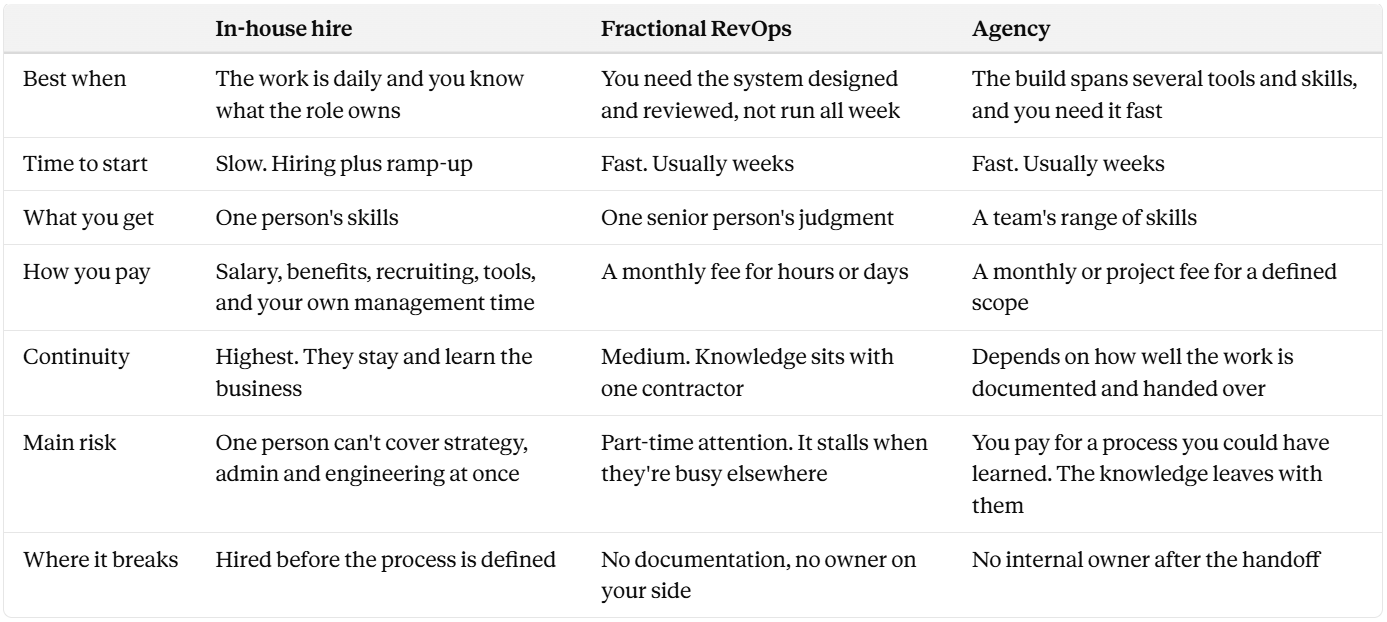
When does an in-house RevOps hire make sense?
When the work is there every day and you can say what the person will own in one paragraph. Typically that's more than one GTM team depending on the same data, a CRM that needs constant care, and enough going on that a person would be busy for a full week.
Two things to be honest about.
First, the first RevOps hire is usually asked to do too much. Strategy, CRM admin, reporting, integrations, process design. That's three or four jobs. One person who's good at all of them is rare, and the one you can afford often isn't.
Second, hiring takes a while, and a new person needs time to learn your business before they fix anything. If your handoffs are breaking now, a hire in three months doesn't help this quarter.
When does fractional make sense?
When you know the system is a mess, you need someone who's seen it done properly, and you don't need that person five days a week.
It works best at the stage where the motion is starting to repeat. A fractional operator can agree the definitions with your teams, clean the CRM, set up the handoffs and metrics, and leave you with something that runs. Some teams then hire a full-time person to run it. That's a sensible path, and it's a cheaper way to learn what the full-time role should actually be.
Where it goes wrong:
- Part-time attention. If they're busy with another client during your launch week, you wait.
- Knowledge in one head. If they leave, so does the explanation. Make documentation a part of the deal, not a nice-to-have.
- No owner on your side. Someone inside still has to approve changes and chase the teams.
When does an agency make sense?
When the job covers several things at once. For example, a CRM rebuild, enrichment, automation and reporting, all needing to work together, in weeks, with skills no single person has.
It's also the fastest way to get a working system when you don't know what good looks like yet.
Where it goes wrong:
- Scope. You get what's in the scope. If the real problem is somewhere else, you find out late.
- The handoff. When the work finishes, someone inside needs to run it. If nobody can, it decays.
- Paying for what you could learn. If the problem is a few days of definitions and clean-up, an agency may be more than you need.
In short, If you have no CRM yet, no repeatable sales motion and nobody who could own the system, we'd tell you to wait. If you only need a few days of clean-up, a fractional person or your own team is probably cheaper. If the role is clearly full-time and ongoing, hire in-house.
Five mistakes we see
- Hiring to fix a process nobody has defined. A person can't fix a process nobody agreed on. Write the definitions first, or hire someone to write them with you.
- Hiring on the title. "RevOps manager" means different things in different companies. Decide the first-90-day problem, then hire for that.
- Buying an agency with no internal owner. The work will get done and then it'll rot.
- Going fractional with nothing written down. Ask for documents, a changelog and a handoff plan from week one.
- Choosing on price. The cheapest option that doesn't fix the problem is the most expensive one.
What should you ask before you sign anything?
- Who will actually do the work, and how much of their week is mine?
- What will be different in 30 days? In 90?
- What do you document, and where does it live?
- What happens at the end of the contract? Can my team run it without you?
- Who owns the logins and admin access to my systems?
- What would you tell me not to do right now?
- Can I talk to a team at the same stage that you worked with?
Fractional vs Agency vs In-house hire: What does each option cost?
These are rough figures for hiring in India or working with an India-based provider, as of late 2026. They're ranges to sanity-check a quote against, not quotes. Where you land depends on scope, seniority and how much of the work is building something new versus looking after it.
In-house hire
What you pay a year depends mostly on experience:
- Analyst or ops specialist, up to about 3 years in: around ₹9L to ₹20L. Good for CRM admin and reporting. Not the person to design the system.
- RevOps manager or lead, about 3 to 7 years: around ₹25L to ₹40L, and up to ₹60L for someone with strong SaaS and US-market experience.
- Head of RevOps, 8+ years: from about ₹70L, and ₹1 crore or more at the top end.
That's the pay, not the cost. On top of it come, software seats for the tools they'll run, the months before they're fully productive, and the hours your own manager spends with them.
Budget well above the headline number for the first year.
Fractional or agency
Scope moves this price more than anything else. Three rough levels, per month:
- Light, advice and audit. A few days a month. They review your setup, agree the definitions, write the plan, and check what your team has built. About ₹75K to ₹2L (roughly $800 to $2,000).
- Standard, design and build. Around 8 to 15 days a month of hands-on work: CRM structure, handoffs, metrics and dashboards, with some ongoing care. About ₹2L to ₹5L (roughly $2,000 to $5,200).
- Full, a team on the build. A CRM rebuild or migration, enrichment, automation and reporting across several tools, with a manager on top. About ₹5L to ₹12L or more (roughly $5,000 to $12,500 and up).
What pushes the price up: more tools to connect, a migration, more teams and sales motions, messy data, complex reporting, and a short deadline. What brings it down: one clean CRM, definitions already agreed, and a team that will do part of the work. Big builds are often a fixed project first and a smaller monthly fee afterwards.
If you're comparing an India-based provider with a US or UK quote, expect a wide gap. US and UK sources put a solo fractional operator at roughly $3,000 to $15,000 a month and a RevOps agency at roughly $8,000 to $27,000.
Put side by side
A ₹30L hire is about ₹2.5L a month in base pay, which is close to the middle fractional level above. So the price isn't what separates them. You're choosing between one person every day and a senior person for a few days a month with a plan and a team behind them. Don't choose on cost alone.
Our own RevOps work is scoped to your stage and the problem.
What we'd do at each stage
- Early, founder-led: probably none of the three yet. Agree the definitions, clean the CRM and keep one tool where you can.
- Starting to repeat: a fractional person or an agency to design and build it, with one person inside who owns it.
- Scaling: an in-house lead to run it day to day, with specialist help brought in for big builds like a migration.
For how this fits into the bigger picture, see the RevOps guide.
If you're ready to compare providers, read the best RevOps agencies for B2B SaaS [add the link when A4 is live].
Not sure when to hire at all? when to hire your first RevOps person has everything you need to know. [add the link when A3 is live].
If you want to talk it through, book a free RevOps readiness call [CONFIRM the link]. We'll tell you which of the three fits your motion.
FAQs:
1. What is fractional RevOps?
It's a senior RevOps person who works with your company for a set number of hours or days each month instead of full-time. They usually design and set up the systems, review them, and advise your team.
2. Is fractional RevOps worth it?
It's worth it when you need experienced judgment and a working system but not a full week of work, every week. It's not worth it if nobody on your side will own the changes, or if you need daily hands-on work.
3. What's the difference between fractional RevOps and an agency?
Fractional is usually one senior person. An agency is a team with different skills working on a defined scope. The words overlap, so ask who will do the work and how much of their week is yours.
4. When should I hire a full-time RevOps person instead?
When the work is daily and ongoing, you can describe what the role owns, and more than one team depends on the same systems. Many teams get there after a fractional person or an agency has built the first version.
5. Can a fractional RevOps person replace a full-time hire?
For a while, yes, and for some teams for good. Once the amount of daily work outgrows the hours, or you need someone embedded in the team, the full-time role starts to make sense.
6. How long before I see results?
You should see cleaner definitions and a working handoff within the first few weeks. Metrics like conversion and forecast accuracy usually take around a quarter to move, so judge on that timescale.
7. How do I choose between the three?
Start with the problem. If it's a build across several tools, an agency. If it's design and oversight, fractional. If it's daily ongoing work you can clearly describe, in-house. Then check who will own the result on your side.