Expanding outbound into a new territory sounds simple from the outside.
Pick a geography.
Pull a list.
Translate the pitch if needed.
Run the sequence.
But new markets rarely behave like your current market.
The same persona may not own the budget.
The same pain may not be urgent.
The same channel may not get replies.
The same proof may not carry trust.
So the job is not to “launch outbound” in a new territory.
The job is to validate whether your GTM motion works there.
TL;DR
Expanding outbound into a new territory isn’t just about building a bigger list. Treat the new market as a test first.
- Start narrow: Pick a specific country, segment, persona, use case or signal-led cohort.
- Rebuild your ICP: Don’t assume the same buyer, pain or buying process works everywhere.
- Find local signals: Look for the events and triggers that actually create urgency in that market.
- Adapt the motion: Localise the value proposition, proof, channels and CTA, not just the copy.
- Run a 60–90 day test: Compare segments, signals and channels before scaling.
- Scale what repeats: If qualified meetings and clear buying signals keep coming from the same cohort, scale it. If not, pivot or pause.
The goal isn’t to prove that a market works. It’s to find out quickly whether your outbound motion can work there.
Why New Territory Outbound Fails
Most expansion campaigns fail because teams copy the old playbook into a new market.
Common mistakes:
- assuming the same ICP works everywhere
- using global messaging without local relevance
- selling the same pain without checking urgency
- ignoring local buying committees
- relying only on email
- not adapting proof, case studies or pricing context
- judging success only by reply rates
- scaling before learning
Step 1: Pick a Territory Wedge, Not an Entire Market
Purpose
Before targeting “US,” “Middle East,” “SEA,” or “Europe,” narrow the wedge.
A useful wedge could be:
- one country
- one region
- one industry
- one company size band
- one use case
- one persona
- one trigger-led cohort
Example
Instead of:
“Target the US market.”
Use:
“Target 200–1,000 employee B2B SaaS companies in the US that recently hired a VP Sales and are expanding SDR teams.”
Territory selection checklist
Evaluate each territory on:
- account availability
- urgency of problem
- buying power
- channel accessibility
- competition intensity
- local proof needed
- sales cycle complexity
- legal/compliance constraints
- language or cultural friction
- availability of signals
Note: expansion works better when a new geography is treated as a test cohort first: US-first, GCC-first, SEA-first, India-first, etc., rather than broad multi-market blasting.
Step 2: Rebuild the ICP for the New Territory
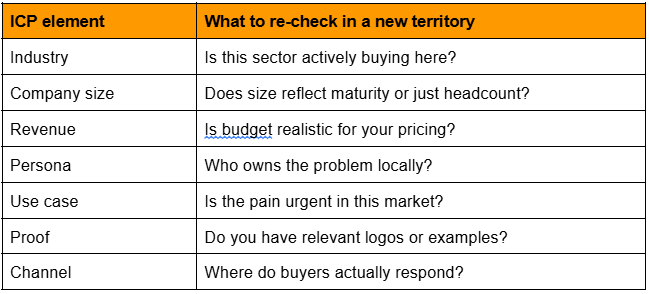
Your ICP is not automatically portable.
The same company size may mean different maturity in different markets.
A 500-person company in India, the US, Singapore and UAE may have very different:
- budgets
- decision-making structures
- tool maturity
- outsourcing appetite
- buying timelines
- founder involvement
- procurement process
- preferred channels
Step 3: Identify Territory-Specific Buying Signals
Signals change by market.
A signal that works in the US may not work in the Middle East.
A signal that works for SaaS may not work for manufacturing.
A signal that works for enterprise may not work for mid-market.
Signal categories
Fit signals
- industry
- revenue
- geography
- size
- business model
- growth stage
Problem signals
- hiring for a specific role
- operational expansion
- new function being built
- manual process at scale
- poor tool fit
- customer growth
- compliance pressure
Timing signals
- funding
- leadership change
- new market entry
- regulation
- restructuring
- large project launch
- upcoming event participation
Engagement signals
- webinar registration
- website visit
- report download
- LinkedIn engagement
- pricing page visit
- email reply
- past conversation
For US SaaS expansion:
- new CRO
- SDR hiring
- Series A/B funding
- US market entry
- CRM or RevOps hiring
For GCC enterprise services:
- government project activity
- event participation
- regional expansion
- procurement or partnership signals
- local office setup
For manufacturing:
- plant expansion
- export growth
- compliance changes
- supplier/vendor evaluation
- capacity or operations hiring
For a deeper breakdown, Signal-Led Outbound: How B2B Teams Can Find Buyers Who Are Actually in Market
Step 4: Localise the Value Proposition, Not Just the Copy
Territory localisation is not changing “US” to “UAE” in the first line.
It means adapting:
- pain point
- proof
- urgency
- business outcome
- terminology
- channel tone
- CTA
- objection handling
Research point
CSA Research found that 76% of online shoppers prefer products with information in their own language, and 40% will not buy from websites in other languages. While this is consumer-focused research, it is a strong reminder that market expansion cannot ignore language, trust and local buying context.
Practical examples
Weak localisation:
“We help companies in the Middle East improve sales.”
Better localisation:
“We’ve been speaking with UAE-based exhibitors preparing for GITEX, and one common challenge is making the booth communicate value quickly when visitors are moving between hundreds of brands.”
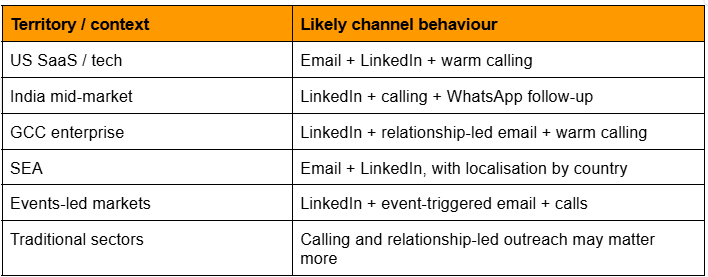
Step 5: Choose Channels Based on Territory Behaviour
Do not assume email, LinkedIn and calling behave the same everywhere.
Channel performance changes by:
- geography
- seniority
- industry
- role
- local communication habits
- data availability
- trust level
- urgency
Channel guidance
Step 6: Build Territory-Specific Proof
New markets need trust.
A buyer in a new territory may not care about your strongest case study if it feels too distant from their world.
Proof assets to prepare
- local or region-relevant case studies
- industry-specific proof
- benchmark reports
- customer stories
- event-specific insights
- market entry lessons
- competitor comparison pages
- ROI calculators
- buyer guides
- “what we’re seeing in this market” content
Step 7: Run a 60–90 Day Territory Validation Sprint
Do not scale too early.
Run a small validation sprint first.
Suggested sprint structure
Week 1–2: Territory research
- define wedge
- map ICP
- identify buying committee
- collect market signals
- review competitors
- prepare proof assets
Week 3–4: Account and persona build
- build account list
- enrich contacts
- segment by signal strength
- classify accounts into nurture, outbound and ABM
Week 5–8: Outreach test
- test 2–3 messages
- test 2–3 signal cohorts
- test channels
- run LinkedIn, email and warm calling
- capture objections
Week 9–12: Learn and decide
- compare cohorts
- identify best-performing signals
- review meeting quality
- refine ICP
- decide whether to scale, pivot or pause
What not to do
Do not run a 5,000-contact blast and call it market validation.
That only tells you whether a generic campaign failed.
Step 8: Track Learning, Not Just Activity
New territory expansion is a learning problem before it is a pipeline problem.
Metrics to track
Activity metrics
- accounts researched
- contacts enriched
- emails sent
- calls made
- LinkedIn invites sent
Response metrics
- connection rate
- reply rate
- positive reply rate
- call connect rate
- meeting booked rate
Learning metrics
- which signal drove replies
- which segment responded
- which persona cared
- which objection repeated
- which message angle worked
- which channel created the first response
- which meetings were qualified
- which accounts moved to nurture
Pipeline metrics
- qualified meetings
- opportunities created
- pipeline value
- conversion from meeting to opportunity
- sales cycle trend
- territory CAC estimate
Step 9: Decide Whether to Scale, Pivot or Pause
Decision framework
After 60–90 days, decide:
Scale if:
- one or two segments show consistent response
- signal cohorts are clear
- meetings are qualified
- objections are manageable
- channel mix is working
- pipeline quality is acceptable
Pivot if:
- replies come from wrong-fit accounts
- meetings are unqualified
- one persona ignores while another responds
- the pain exists but message needs rework
- channel performance is uneven
Pause if:
- problem is not urgent
- budget is consistently absent
- buying committee is inaccessible
- proof is too weak
- territory has low near-term readiness
If your current outbound setup feels unclear, fix that before adding a new market. Low replies, weak meetings, wrong-fit prospects, or no feedback loop usually point to a system problem, not just a territory problem.
Take the 3-minute Outbound Diagnostic to see where your outbound is leaking across ICP, messaging, execution and systems.
Planning to expand into a new market and want to do it without burning the territory?
Get in touch with the Leadle team and we’ll help you think through the right market wedge, signal map and outbound motion before you scale.
FAQs:
1. How do I expand outbound sales into a new territory?
Start with a narrow territory wedge, rebuild your ICP for that market, identify local buying signals, adapt your value proposition, choose the right channel mix, run a 60–90 day validation sprint and scale only after you see qualified response.
2. How long should a territory validation sprint run?
A good first sprint usually runs 60–90 days. That gives enough time to test segments, signals, channels, messaging and meeting quality before scaling.
3. Should I use the same outbound message in every territory?
No. The core offer may stay the same, but pain points, proof, urgency, objections and CTAs often need to change by territory.
4. What channels work best for new territory outbound?
It depends on the market. Most B2B territory expansion should test a mix of LinkedIn, email, warm calling, content and, in some regions like India or APAC, WhatsApp follow-ups.
5. How do I know if a new territory is worth scaling?
Scale when you see repeatable positive replies, qualified meetings, clear signal patterns, relevant objections and early pipeline from the same segment or cohort.